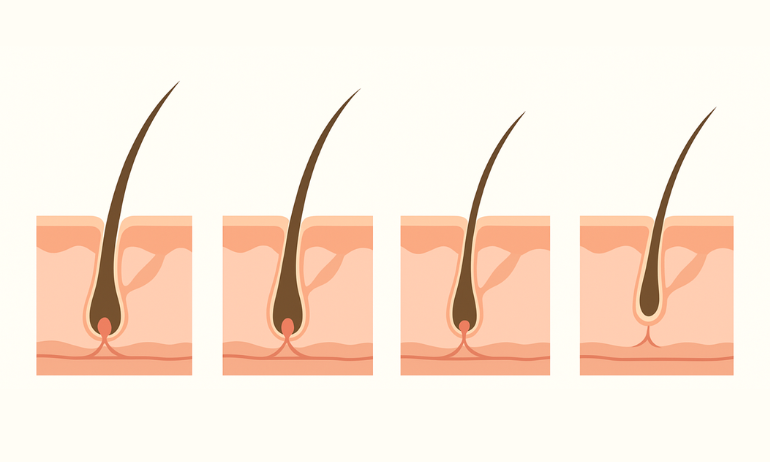
The hair-growth cycle
The hair growth cycle consists of three key stages: the anagen (growth) phase, catagen (transitional) phase, and telogen (resting and shedding) phase. Each hair follicle operates independently, cycling through these phases at its own pace. During the anagen phase, hair actively grows. This phase includes two sub-stages: the propagating anagen phase, where new hair follicles are activated, and the autonomous anagen phase, where the hair grows and follicles differentiate.
The catagen phase follows as a brief transition, eventually leading into the telogen phase, where hair stops growing and is naturally shed from the scalp. On average, this entire cycle repeats about 20 times in a lifetime.
However, this natural hair growth cycle can be disrupted by various internal and external factors. Hormonal imbalances, high stress levels, chronic illnesses, exposure to pollution, and smoking can all interfere with the cycle. Common disruptions include a shortened anagen phase, early onset of the catagen phase, and extended telogen phase, all of which may result in hair thinning or hair loss.
When hair loss becomes noticeable and persistent, it is medically referred to as alopecia, a condition that may require targeted hair care treatments or clinical intervention.